


Edge Computing Use Cases: Real-World Examples by Industry

There are endless edge computing use cases across business scenarios where processing data locally, instead of in the cloud, solves a real latency, connectivity, or bandwidth problem. This article covers what that looks like in practice across a variety of verticals. You will also find a quick summary table, a simple filter for telling an efficient edge use case from a workload that merely happens to run near a device, and a checklist for evaluating your own scenario.
If you need the underlying definition first, read What Is Edge Computing.
Edge Computing Use Cases: Quick Summary Table
Here is the scannable version before the detailed sections below.
| Industry | Examples of What Runs at the Edge | Why It Has to Run There |
|---|---|---|
| Retail | Point of sale and self-checkout, video analytics for loss prevention and inventory, digital signage | Store connectivity is inconsistent, and a checkout outage costs revenue immediately |
| Manufacturing | Predictive maintenance, computer vision quality inspection, production line monitoring | Decisions are measured in milliseconds, and the line cannot stop because the link is slow or dropped |
| Industrial machines and robotics | Robot control software, navigation, sensor and LiDAR processing, fleet monitoring | A machine cannot wait for a cloud round trip to avoid a collision or resume a stalled task |
| Multi-unit restaurants and QSR | Kitchen display systems, digital ordering, order routing | A dropped connection during peak service costs orders directly |
| 5G and telecom | Virtualized distributed units, cloud-native network functions, MEC applications | Network functions have strict timing budgets and must run close to the radio |
| Computer vision and edge AI (cross-cutting) | AI models running inference on live video and sensor data | Streaming raw video to the cloud is too slow for a real-time alert and too expensive in bandwidth |
What Makes Something an Edge Use Case?
Not every workload that runs outside a data center is an edge computing use case. Plenty of software has always run on a server in a back office, and calling it “edge” does not change what it does. An edge use case is one where local processing solves a problem that centralized processing cannot.
The filter process is short. Does the workload need a response in under a few seconds? Does it need to keep operating through a network outage? Would sending the raw data to the cloud be too slow or too expensive? If the answer to any of those is yes, you probably have an edge use case.
If the answer to all three is no, the workload probably belongs in the cloud, and putting it at the edge just adds hardware to maintain.
Edge Computing Use Cases by Industry
The pattern is the same everywhere, but the specifics differ. Here are a few examples of what could run at the edge in each industry, and why it has to.
Retail and In-Store Applications
Retail is one of the fastest-moving industries in edge computing, and the workloads are easy to name. Point of sale and self-checkout run in-store so transactions complete without a round trip. Video analytics applications and AI models process camera feeds locally for loss prevention, queue detection, and shelf and inventory monitoring. Digital signage and in-store personalization run on local hardware so content keeps playing regardless of the network.
The reason is straightforward. Store connectivity can be inconsistent, and unlike an analytics job, checkout cannot be retried later. When the link drops, a cloud-dependent store stops selling. A store running its critical applications locally keeps trading and reconciles with central systems when the connection returns.
Avassa works with retail organizations on exactly this. H&M Group selected the Avassa Edge Platform as part of a broader redesign of its in-store IT infrastructure, and later joined as a strategic investor. Extenda Retail, a retail software provider with point-of-sale, warehouse management, and loyalty solutions deployed in more than 36 countries, uses the platform to deliver and operate in-store application components as part of a hybrid model, so that stores keep running even when the connection to central services is lost or degraded.
Read more: Avassa for Edge, Retail
Manufacturing and Smart Factories
On the factory floor, the workloads that run locally are the ones tied to production timing. Predictive maintenance applications analyze vibration, temperature, and current draw from machines to flag a failing component before it stops the line. Computer vision quality inspection runs AI models against camera feeds to catch defects within the cycle time of the process. Production line monitoring aggregates machine and sensor data on site and acts on it immediately.
None of that tolerates a round trip. A quality check that returns an answer after the part has moved down the line is not a quality check, and a maintenance alert that depends on an available WAN link is not a reliable alert. Local processing also keeps proprietary process data on site, which matters when the data describes how you actually make things.
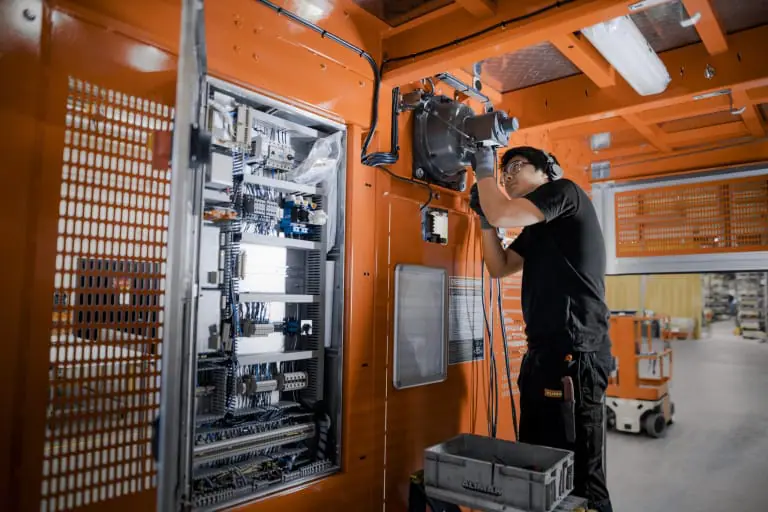
Alimak Group, a global provider of vertical access solutions for construction and industrial environments, selected the Avassa Edge Platform to manage edge applications across its installed base, using IoT and real-time local data processing in environments where connectivity cannot be assumed.
Read more: Avassa for Edge, Industrial and Manufacturing
Industrial Machines and Robotics
Autonomous machines are the clearest case of all, because the physics leaves no room for argument. Robot control software, navigation, path planning, and sensor processing from cameras and LiDAR all run on the machine itself. A robot cannot wait for a cloud round trip to avoid a collision, and it cannot pause mid-task because a mobile network handed over badly.
What runs centrally is everything else: fleet monitoring, software and AI model distribution, telemetry collection, and version control across the fleet. That distinction matters operationally, because machines in the field still need frequent, safe updates, and doing that by hand across a fleet does not scale.
Ekobot, a Swedish precision agriculture company, uses the Avassa Edge Platform to securely distribute and monitor the applications running on its fleet of autonomous agricultural robots. The robots need fast, iterative updates, including regular updates of the AI models that let them adapt to changing field conditions, which is a good illustration of the split: inference in the field, lifecycle management from the center.
Read more: Avassa for Edge, Robotics
Multi-Unit Restaurants and QSR
Quick service restaurants run on a short clock, and their edge workloads reflect that. Kitchen display systems, digital ordering and kiosks, order routing between front counter, drive-through, and kitchen, and local payment processing all need to work at the speed of service.
A connectivity drop during the lunch rush does not delay orders; it loses them, and it does so at the busiest and most profitable moment of the day. Running order capture and routing locally means a site keeps serving through an outage and syncs sales data centrally afterwards. Multiply that across hundreds of locations and the difference is measured in revenue.
Read more: Avassa for Edge, Multi-Unit Restaurants and QSR
5G and Telecom
Telecom operators were running distributed compute before the industry settled on the word “edge.” Virtualized distributed units and other cloud-native network functions run close to the radio because the timing budgets in radio access networks are measured in fractions of a millisecond. Multi-access edge computing (MEC) puts application workloads at aggregation points and cell sites so that enterprise services benefit from the same proximity.
This is complementary to 5G core orchestration. The core network has its own tooling and its own operational model. The gap is in managing the long tail of application workloads and AI models across many distributed sites with mixed hardware, which is a different problem from managing the core.
Read more: Avassa for Edge, 5G and Telco
Computer Vision and Edge AI Inference
Computer vision is a workload pattern that shows up inside the industries above, and it is worth calling out because it is the single strongest driver of edge adoption right now.
Real-time video and image analysis has two properties that force local processing. First, latency: an alert about a safety violation, a defect, or a theft is only useful while the situation is still happening. Second, bandwidth: a single camera stream is expensive to backhaul continuously, and sites rarely have one camera. Running AI models where the cameras are means you process everything locally and send only events, metadata, and the occasional clip.
You have already seen this pattern above, in retail loss prevention, in production line quality inspection, and in the sensor processing on Ekobot’s robots. What these have in common operationally is that the AI models change often. Models get retrained, tuned, and replaced, and each new version has to reach every site safely, with a way to roll back when a version misbehaves. That lifecycle work is where an edge platform earns its keep.
Read more: What is Edge AI?
What Runs at the Edge vs What Remains in the Cloud?
The general split is consistent across every industry above. Real-time, local, and offline-critical workloads run at the edge. Long-term storage, cross-site analytics, training, and anything that can tolerate a delay run in the cloud.
| Workload Type | Best Placement |
|---|---|
| Real-time inference on live video and sensor data | Edge |
| Point of sale, checkout, and order capture | Edge |
| Machine control, navigation, and safety functions | Edge |
| Local buffering and pre-processing of sensor data | Edge |
| Site monitoring and local event handling | Edge |
| Application and AI model lifecycle management | Both: defined centrally, executed locally |
| Cross-site analytics, dashboards, and reporting | Cloud |
| AI model training and retraining | Cloud |
| Long-term storage, archiving, and audit history | Cloud |
The Avassa Edge Platform follows the same division: Control Tower manages applications, AI models, and policies centrally, while Edge Enforcer runs on the hosts at each site and keeps workloads running locally, including when the site is offline.
How to Evaluate an Edge Computing Use Case
If you are trying to work out whether your own scenario qualifies, run it through these questions to navigate along the way.
- Does it need a sub-second response? If the decision has to happen faster than a network round trip allows, it runs locally. If a few seconds of delay is acceptable, the cloud is simpler.
- Does it need to survive a connectivity loss? Be specific about what “survive” means. Does the site need to keep operating fully, degrade gracefully, or simply buffer data until the link returns?
- How many sites are in scope, now and in three years? Ten sites can be managed manually. Two hundred cannot. The site count determines whether you need an edge platform or a set of scripts.
- How much data is generated locally, and what does moving it cost? Add up the bandwidth for continuous video or high-frequency sensor data. This is often the number that decides the case on its own.
- What data must stay local for compliance reasons? Data residency, GDPR, and industry-specific rules can make local processing a requirement.
- What is your resiliency target per site? Decide what downtime actually costs at one location, then multiply by the number of locations. That figure sets your budget for local redundancy.
- How often will the applications and AI models change? Frequent updates across many sites is an operational problem, not a deployment problem, and it is worth planning for before the first rollout.
If you answer these questions, you will usually find that some of your workloads belong at the edge and others do not. That is the expected outcome, and it is a better starting point than moving everything in one direction.
Conclusion
An edge computing use case is one where local processing solves a real latency, connectivity, or bandwidth problem. It shows up differently in every industry: uninterrupted checkout in retail, predictive maintenance and quality inspection in manufacturing, collision avoidance and navigation in robotics, order continuity in multi-unit restaurants, and network function virtualization in telecom. The common thread is that the workload has to be where the data is. The second, less obvious thread is that once you have decided what runs locally, keeping those applications and AI models updated and observable across every site becomes the real work.
Ready to see how Avassa manages edge deployments across your own distributed sites?
Frequently Asked Questions
Is edge computing only useful for large enterprises?
No. The deciding factor is the constraint, not the company size. A single location with a genuine latency, connectivity, or compliance requirement is a valid edge computing use case. What changes with scale is the operational burden: a few sites can be managed manually, while hundreds of sites need an edge platform to keep applications and AI models consistent, updated, and observable.
How is an edge computing use case different from a general edge computing application?
An edge computing application is any software that runs on edge infrastructure. A use case is the business scenario that justifies it. The distinction matters because software can technically run at the edge without benefiting from it. If the workload does not need local processing for latency, resilience, or bandwidth reasons, it is an application at the edge rather than an edge use case.
Can a single site test edge computing before rolling out to more locations?
Yes, and starting with one or two sites is the normal path. A pilot lets you validate the workload, the hardware, and the operational model before committing to a wider rollout. The main advice is to choose tooling at the pilot stage that will still work at a hundred sites, because the manual approach that works for one location rarely survives scaling.
What happens to data collected at the edge if a site loses internet connectivity?
That depends on how the applications are designed. In a well-architected edge deployment, applications keep running on local compute, data is buffered on site, and synchronization with central systems resumes when connectivity returns. The Avassa Edge Platform is built for this: Edge Enforcer runs autonomously at the site, handling restarts, failover, and scheduling without a connection to Control Tower, and updates apply once the link is restored.
Do edge computing use cases require replacing existing cloud infrastructure?
No. Edge and cloud are complementary layers. Most deployments keep the cloud for storage, cross-site analytics, and AI model training, and move only the latency-sensitive or offline-critical workloads to the edge. In practice, adopting edge computing usually means adding a local execution layer to an existing cloud architecture rather than replacing anything.