


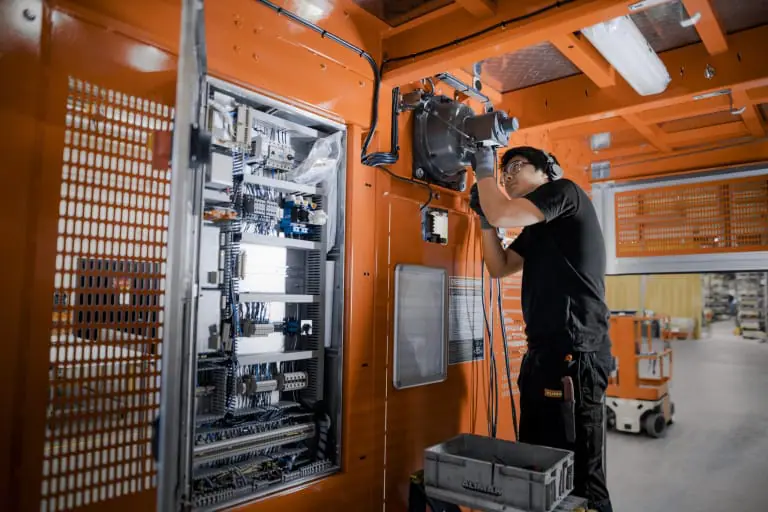
Industrial Edge Computing: Scaling Smart Factory Operations in 2026

Edge computing in manufacturing moves computation closer to machines and production lines, enabling smart factories to run with real-time responsiveness, operational autonomy, and scalability across distributed industrial environments.
Smart factories are the cornerstone of Industry 4.0, integrating advanced automation, IoT sensors, and AI-driven analytics into manufacturing operations. These environments generate massive volumes of time-sensitive data that must be processed instantly to control machinery, maintain quality, and ensure worker safety. Cloud computing remains critical for central analytics and long-term storage, but relying solely on it creates latency, reliability, and compliance challenges. Edge computing in manufacturing addresses these limitations by processing data on the shop floor, enabling decentralized intelligence and rapid, autonomous action.
This article explores why edge computing is essential in modern manufacturing, how it supports distributed production models, and how platforms like Avassa orchestrate these deployments at scale.
Edge Computing vs Cloud in Smart Factories
Both edge and cloud computing play important roles in modern industrial architecture. The table below clarifies where each excels:
| Feature | Edge Computing | Cloud Computing |
|---|---|---|
| Latency | Sub-millisecond, on-site | Tens to hundreds of milliseconds |
| Reliability | Operates offline; no internet dependency | Requires stable network connectivity |
| Real-time action | Yes: immediate, local execution | Limited: round-trip delay prevents true real-time |
| Scalability | Scales across distributed sites via edge orchestration | Highly scalable for centralized workloads, but not on-site |
| Best for | Machine control, quality inspection, safety | Long-term storage, analytics, ERP integration |
Edge and cloud are complementary. The most effective smart factory architectures use edge computing for time-sensitive operations and the cloud for strategic analytics and long-term planning.
Bridging the Gap: Edge Computing in IoT-Based Manufacturing
Cloud computing is indispensable for large-scale analytics, long-term storage, and centralized coordination. However, smart factories operate in environments where milliseconds matter, and where network connectivity cannot always be guaranteed. Edge computing complements the cloud by ensuring critical operations continue even during outages or delays.
Smart factories are the cornerstone of Industry 4.0, integrating advanced automation, IoT sensors, and AI-driven analytics into manufacturing operations. These environments generate massive volumes of time-sensitive data that must be processed instantly to control machinery, maintain quality, and ensure worker safety. Edge computing in manufacturing addresses these limitations by processing data on the shop floor, enabling decentralized intelligence and rapid, autonomous action.
1. Real-Time Responsiveness at the Machine Level
Applications like robotics control, conveyor belt coordination, and safety systems require sub-millisecond response times that cloud round-trips simply cannot provide. Edge nodes process sensor data locally, issuing commands in microseconds rather than waiting for a cloud response.
2. Operational Continuity in Intermittent Networks
Many manufacturing facilities, particularly those in remote or industrial zones, experience unreliable WAN connectivity. Edge computing ensures that production-critical applications continue operating locally, with data synchronized to the cloud only when connectivity is restored.
3. Compliance and Data Sovereignty
Regulations such as GDPR and sector-specific standards often require that sensitive production data remain within defined geographic or organizational boundaries. Processing data at the edge means it never needs to leave the facility.
4. Cyber-Resilience and ISA-95 Compliance
Industrial edge deployments can be architected to enforce the ISA-95 demilitarized zone model, isolating OT (operational technology) networks from IT and cloud systems. This limits the blast radius of cyberattacks and ensures that a breach at the cloud layer cannot directly compromise plant floor operations. Segmenting workloads at the edge also simplifies audit compliance for standards such as IEC 62443.
Distributed Manufacturing at Scale: Powered by Edge
As manufacturing operations expand across multiple sites, edge computing becomes the enabling layer that keeps each facility autonomous while remaining coordinated with the broader enterprise.
What Is Distributed Manufacturing?
Distributed manufacturing refers to a production model in which manufacturing activities are spread across multiple geographically dispersed facilities, rather than being centralized in a single plant. Each site operates semi-autonomously, with local intelligence handling real-time decisions while remaining coordinated with the broader enterprise.
How Edge Enables Local Autonomy Across Sites
Each factory site requires its own localized edge stack, compute, networking, and application infrastructure that can operate independently from a central orchestrator. This allows operators to define how applications are deployed across these sites without logging into each one manually.
Observability in a Unified Control Plane
When running dozens or hundreds of edge sites, visibility becomes critical. Operators needs a single pane of glass across all sites, surfacing metrics, logs, and health status from every edge node in real time.
Learn more: Observability at the Edge
Edge Computing Use Cases in Manufacturing
From predictive maintenance to adaptive production lines, edge computing is already delivering measurable operational improvements across a wide range of manufacturing environments. Here are a few examples.
1. Predictive Maintenance and Asset Monitoring
Vibration sensors, thermal cameras, and acoustic monitors stream continuous data from rotating equipment. Edge AI models analyze this data locally to detect anomalous patterns, bearing wear, thermal runaway, and imbalance, and trigger maintenance alerts before failure occurs, reducing unplanned downtime by up to 50%.
2. Quality Assurance with Edge AI Vision Systems
High-resolution cameras inspect products on the production line at speeds exceeding human perception. Computer vision models deployed at the edge detect surface defects, dimensional errors, and assembly mistakes in real time, rejecting non-conforming units without halting the line.
3. Adaptive Production Lines
Edge controllers receive production schedule changes from ERP systems and dynamically reconfigure line parameters, speed, temperature, and tooling offsets across connected machines. This enables rapid changeovers and reduces the engineering time required for new product introductions.
4. Energy Optimization and Efficiency
Edge platforms aggregate energy consumption data from motors, HVAC systems, compressors, and lighting across the plant. Local analytics models identify demand spikes, idle waste, and optimization opportunities, enabling real-time load balancing and measurable reductions in energy costs.
How Can Manufacturers Deploy and Manage Edge Applications Across Multiple Factories?
Managing edge computing across a multi-site manufacturing enterprise is one of the most operationally complex challenges IT and OT teams face. The answer lies in Edge Orchestration, a centralized management approach that treats all distributed edge sites as a single, programmable infrastructure.
Rather than logging into each factory’s systems individually to push updates, change configurations, or deploy new applications, Edge Orchestration platforms like the Avassa Edge Platform allow operators to manage all sites from a single control plane.
Key capabilities include:
- Tag-based deployment: Devices, applications, and locations are grouped using logical tags (e.g., “region: EMEA”, “line-type: automotive”, “tier: production”). Updates, policies, and new application versions are applied to any combination of tags simultaneously, meaning a single policy push can reach 100+ factories at once.
- Declarative application deployment: Operators define the desired state of each application, and the platform continuously reconciles the actual state against that definition across all sites.
- Automated deployment and rollback: New versions can be staged, canary-tested across a subset of sites, and rolled back automatically if health checks fail, without manual intervention.
This approach eliminates the operational bottleneck of site-by-site management and dramatically reduces the risk of configuration drift between factories.
Benefits of Edge Computing in Manufacturing
The move from centralized cloud-only architectures to edge-enabled smart factories delivers measurable operational advantages:
Reduced Latency and Real-Time Responsiveness: By processing data within the facility, often within the same rack as the machinery it controls, edge computing eliminates the round-trip delay inherent in cloud architectures. This enables microsecond-level response times for robotic control, safety interlocks, and quality inspection systems that simply cannot tolerate network latency.
Reduced Downtime Through Predictive Maintenance: Edge AI models run continuously against sensor streams, identifying degradation patterns in equipment before they result in failure. Unlike cloud-based analytics that depend on periodic data uploads, edge-based predictive maintenance operates in real time, catching faults at the earliest possible stage and allowing maintenance to be scheduled during planned downtime windows.
Lower Bandwidth Costs and Reduced Cloud Dependency: Industrial IoT environments generate enormous volumes of raw sensor data. Transmitting everything to the cloud is expensive and, for many use cases, unnecessary. Edge computing filters, aggregates, and processes data locally, sending only meaningful events, alerts, and summaries to the cloud. This reduces WAN bandwidth consumption by a significant margin and lowers monthly cloud infrastructure costs.
Technologies Driving the Industrial Edge Evolution
Edge computing in manufacturing is powered by a combination of hardware, software, and integration technologies. These components work together to enable secure, efficient, and scalable operations.
1. Edge Hardware and Industrial IoT Devices
This includes programmable logic controllers (PLCs), industrial gateways, high-resolution cameras, and connected sensors — all built for harsh environments.
2. Lightweight Containerization for the Factory Floor
Containers like Docker or Podman run efficiently on constrained hardware, enabling modular, easily updated applications. Hardware-based PLCs are being replaced by soft PLCs, which enable agile feature growth and integration with other software components.
3. Edge Orchestration Without Complexity
At the industrial edge, you should avoid the complexity of Kubernetes; instead, perform application lifecycle management, observability, and security with tooling tailored to distributed edge environments.
4. Integration with Existing Factory Systems
Edge deployments must interoperate with MES (Manufacturing Execution Systems), SCADA (Supervisory Control and Data Acquisition), and ERP (Enterprise Resource Planning) systems through secure APIs.
How to Implement Edge Computing in Manufacturing
Deploying edge computing in a factory setting requires careful planning, the right technology stack, and processes that bridge IT and OT teams. This section offers a step-by-step approach to edge computing implementation.
Step 1: Assess Your Edge Readiness
Evaluate your network topology, number of sites, and specific security or compliance requirements.
Step 2: Select the Right Edge Stack
Choose suitable hardware, operating systems, containerization tools, and orchestration platforms that can handle industrial conditions.
Step 3: Deploy and Manage Applications Across Sites
Implement CI/CD pipelines for the edge, enabling smooth transitions from development to production, with rollback capabilities.
Step 4: Secure and Monitor Your Edge Infrastructure
Apply strict user access controls, log all activities, and continuously monitor the health of edge nodes.
Common Challenges and How to Overcome Them
Even with a clear strategy, manufacturers face hurdles in edge adoption. Addressing these early can save both time and operational risk.
1. Lack of Visibility Across Edge Locations
Without centralized oversight, software versions and configurations can drift. Avassa offers a unified dashboard for full lifecycle visibility.
2. Fragmented Tooling Between Dev and Ops
OT and IT often operate in silos, leading to integration challenges. Edge-friendly CI/CD pipelines bridge the gap.
3. Security and Lifecycle Management at the Edge
Updating and patching distributed devices is complex. Policy-driven deployments and automated rollbacks reduce security risks.
What’s Next: The Future of Edge in Smart Factories
The evolution of edge computing in manufacturing will be defined by greater autonomy, smarter AI integration, and broader interoperability. These trends will shape the next decade of industrial innovation.
Towards Autonomous Production Networks
Factories will increasingly embed decision-making capabilities directly into their operations, reducing human intervention in routine adjustments.
AI-Driven Edge Intelligence
Machine learning models trained centrally will be deployed locally for real-time inference, enabling faster quality control and predictive maintenance.
Interoperability Through Open Standards
Protocols like OPC UA, MQTT, and ISA-95 will ensure smooth integration between edge systems and legacy industrial platforms.
Avassa’s Vision for Agile Industrial Edge Orchestration
Self-service deployment portals, zero-touch provisioning, and full-stack observability will define the next generation of industrial edge operations.
Conclusion
Edge computing in manufacturing is no longer a future-facing concept, it is a production-ready foundation for smart factory operations in 2026. By processing data at the source, manufacturers eliminate latency, improve resilience, and unlock AI-driven automation that cloud-only architectures cannot support. Fleet orchestration platforms like Avassa make it possible to deploy, manage, and scale edge applications across hundreds of distributed sites from a single control plane. Whether the goal is predictive maintenance, real-time quality inspection, or energy optimization, edge computing provides the infrastructure layer that makes Industrial IoT actionable.
Building an infrastructure stack for AI-ready IT/OT: From design to reality
The software stack in industrial environments is rapidly moving away from proprietary and vertically integrated systems into platforms and modern software tools. The drivers include the need for increased agility and the need to explore the use of applied AI in production environments. With a new and diverse software stack comes the unavoidable challenge of not only acquiring and developing but also robustly deploying and managing applications at scale to meet the demands of the business.
This session will discuss the architectural outlines of a purpose-built IT infrastructure stack for IT/OT based on best-of-breed components and dive deep into a real-world example from a major tool manufacturing company. The talk will interest OT managers and engineers by showing how adopting a layered approach to infrastructure provides a solid base for current and future applications on the factory floor.
Speakers: Carl Moberg, Avassa & Micael Baudin, SECO Tools
Frequently Asked Questions
What is edge computing in manufacturing?
Edge computing in manufacturing is the practice of processing data near its source, on the factory floor or at local compute nodes, rather than sending it to a remote cloud. This enables real-time decision-making, autonomous operation, and reduced latency for time-critical industrial processes.
How does edge computing help smart factories?
Edge computing gives smart factories the ability to act on data instantly, continue operating during cloud or network outages, enforce data sovereignty, and run AI workloads locally. It is the foundational technology enabling Industry 4.0 autonomy.
What are the major benefits of edge computing for smart factories?
The primary benefits are reduced latency (enabling real-time machine control), reduced downtime through predictive maintenance, lower bandwidth costs, improved resilience, and stronger data security through local processing and network segmentation.
How does edge computing support real-time decision-making on the factory floor?
By deploying compute resources directly at or near the machines, edge systems eliminate the round-trip delay to a cloud server. This allows safety systems, robotic controllers, and quality inspection cameras to act in microseconds. Far faster than any cloud-dependent architecture could achieve.
What challenges should manufacturers consider when deploying edge computing?
Key challenges include managing hardware diversity across many sites, ensuring consistent security posture across distributed nodes, integrating with legacy OT systems, maintaining software currency across fleets, and building in-house or vendor-supported expertise for edge orchestration.
What is the role of IoT in edge computing for manufacturing?
IoT sensors and devices are the primary data sources in a smart factory. Edge computing acts as the intelligence layer that processes IoT data locally, filtering noise, running inference models, and triggering automated responses, before selectively forwarding relevant data to the cloud for long-term analysis.