


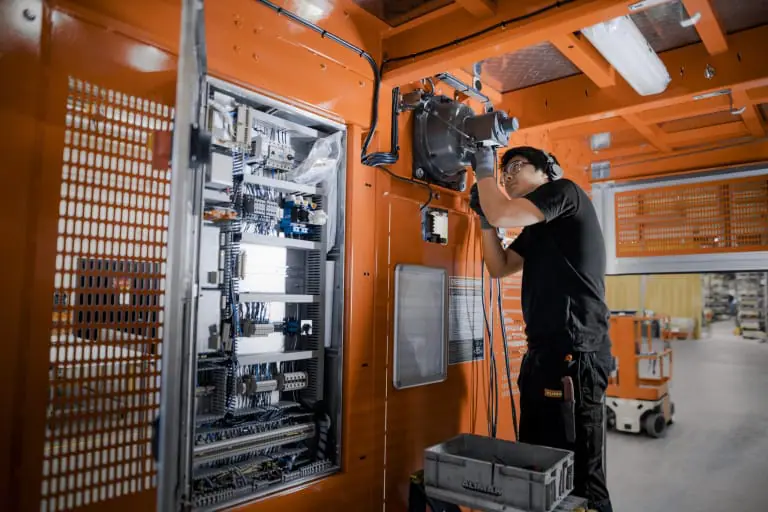
Software-Defined Industrial Automation: Transforming Manufacturing with Edge Computing

Software-defined industrial automation is reshaping how manufacturers operate, replacing rigid hardware-bound systems with flexible, software-centric architectures. By combining factory automation software, edge computing, and open standards, modern plants gain real-time intelligence, lower upgrade costs, and the agility to adopt new technologies without ripping out existing infrastructure. This article explains what industrial automation is, how the software-defined model differs from legacy systems, and what manufacturers need to know to make the transition.
What Is Industrial Automation? Definition & Evolution
Industrial automation refers to the use of control systems, software, and hardware technologies such as PLCs, SCADA, and robotics to automate manufacturing processes with minimal human intervention. Its primary goal is to improve efficiency, accuracy, scalability, and safety in industrial operations.
Software-defined industrial automation refers to a new paradigm where software takes the central role in controlling, optimizing, and managing industrial processes. This shift enables a higher degree of flexibility, scalability, and integration with modern digital technologies compared to legacy systems.
Historically, industrial automation has been dominated by proprietary and closed systems like SCADA (Supervisory Control and Data Acquisition) systems and physical PLCs (Programmable Logic Controllers). These technologies have provided reliable, though limited, capabilities. However, in today’s rapidly evolving digital era, where agility, innovation, and seamless integration with cutting-edge software technologies are paramount, these legacy systems are no longer sufficient.This paper explores how next-generation industrial automation solutions are moving from hardware-bound, vendor-specific systems to open, flexible, and software-defined architectures. This transformation is paving the way for the future of Industry 4.0, where automation is increasingly driven by software, allowing greater customization, faster innovation, and a more streamlined production process.
The Challenges of Legacy Industrial Automation Systems
Traditional industrial automation systems were designed for stability and longevity, not adaptability. As manufacturers face increasing pressure to innovate, the limitations of these legacy environments have become impossible to ignore.
Many plants still rely on hardware-locked PLCs and SCADA systems that are deeply proprietary, meaning any modification or upgrade requires vendor involvement, lengthy procurement cycles, and significant capital expenditure. Integration with modern software tooling, such as machine learning pipelines or cloud analytics platforms, is either extremely complex or simply not supported.
Beyond cost and flexibility, legacy systems create operational silos. OT (Operational Technology) and IT (Information Technology) remain disconnected, preventing manufacturers from leveraging real-time data to drive smarter decisions. Security vulnerabilities in aging systems compound the risk, as many were designed long before cybersecurity was a primary concern.
The result is a growing gap between what modern manufacturing demands and what traditional automation infrastructure can deliver.
Keep Reading: Avassa for Industrial Edge
Software-Defined Automation: Disrupting Traditional Hardware Models
Today’s leading factory automation software platforms are dismantling the assumptions that have defined industrial control for decades. Traditional industrial automation relies on rigid, hardware-defined architectures that limit scalability and innovation. By shifting to a software-centric model, manufacturers can overcome these challenges and future-proof their operations.
The future of industrial automation lies in disaggregating the traditional model by adopting a software-centric approach. Virtual PLCs, containers, and edge computing, in combination with commercial off-the-shelf (COTS) hardware, offer a flexible solution that eliminates dependency on proprietary systems. By leveraging open standards and modern software tools, manufacturers can seamlessly integrate machine learning, advanced programming languages, and continuous integration/continuous deployment (CI/CD) pipelines into their automation systems.
4 Strategic Benefits of Software-Defined Automation
The shift from hardware-defined to software-defined automation delivers meaningful advantages across operational, financial, and strategic dimensions.
- Flexibility and Agility: Software-defined systems can be updated, reconfigured, and scaled without physical hardware changes, enabling manufacturers to respond quickly to new product lines or process requirements.
- Cost Efficiency: Replacing proprietary hardware with COTS infrastructure and software updates significantly reduces capital and maintenance costs over the lifecycle of the system.
- Integration with Modern Technologies: Open architectures allow seamless integration with AI, machine learning, and cloud platforms, enabling advanced analytics and predictive capabilities.
- Vendor Independence: By moving away from locked-in proprietary systems, manufacturers retain control over their technology roadmap and can adopt best-of-breed solutions as the market evolves.Key components of this new architecture include:

Industrial Edge Computing: Bringing Intelligence to the Shop Floor
Industrial edge computing brings compute, storage, and intelligence directly to the production environment. By processing data locally, manufacturers can act on insights in real time without the latency, bandwidth costs, or reliability risks associated with cloud-dependent architectures.
The role of edge computing in industrial automation has expanded significantly as manufacturers deploy more connected devices and sensors across their facilities. Managing these deployments consistently, securely, and at scale requires a dedicated edge management layer, exactly what platforms like the Avassa Edge Platform are designed to provide.
Leveraging Edge AI for Advanced Manufacturing Software
Edge AI takes the value of edge computing further by embedding machine learning inference directly at the point of operation. This enables capabilities that simply are not achievable with centralized processing alone.
Edge AI specifically enables benefits like:
- Predictive maintenance: Models running at the edge can detect early signs of equipment degradation and trigger maintenance workflows before failures occur, reducing unplanned downtime.
- Real-time quality control: Vision systems and sensor fusion running locally can flag defects mid-production, preventing waste and rework.
- Adaptive process control: AI models can adjust process parameters on the fly based on live sensor data, optimizing output without human intervention.
- Reduced data transfer costs: By filtering and processing data at the edge, only meaningful insights and aggregated metrics need to be sent to central systems, reducing bandwidth consumption significantly.
Comparison: Traditional vs. Next-Generation Industrial Automation
Understanding the practical differences between legacy and software-defined architectures helps manufacturers make the case for modernization internally and prioritize where to start.
The table below summarizes the key distinctions between traditional hardware-bound automation and modern software-defined approaches:
| Dimension | Legacy Automation | Software-Defined Automation |
|---|---|---|
| Controllers | Hardware PLCs | Virtual/containerized soft PLCs |
| Architecture | Vendor-locked, proprietary | Open, modular, standards-based |
| Upgrades | Hardware replacement, high cost | Software updates, low friction |
| Integration | Limited, siloed | Cloud, AI, and analytics-ready |
| Scalability | Physical constraints | Scale via software deployment |
| IT/OT Alignment | Disconnected | Converged, unified data layer |
| Maintenance | Reactive, manual | Predictive, automated |
The Future of Industrial Automation Platforms & Next-Generation Industrial Automation
The industrial automation landscape is entering a new era, defined not by what hardware can do, but by what software enables. The convergence of IT and OT is no longer a distant goal — it is actively happening in forward-looking manufacturing facilities around the world.
Several trends are shaping the trajectory of next-generation industrial automation. IT/OT convergence is breaking down the walls between the plant floor and enterprise systems, enabling a unified data flow from sensor to boardroom. Modular system architectures allow manufacturers to assemble and reconfigure automation stacks from interoperable components, reducing time-to-production and lowering integration risk. The adoption of open industrial standards, such as OPC-UA and containerized workload management, means that software developed today can run on the hardware of tomorrow.
Platforms like the Avassa Edge Platform play a central role in this evolution, providing the operational layer that allows manufacturers to deploy, manage, and update distributed edge applications consistently across hundreds or thousands of sites. This kind of software-defined control over edge infrastructure is what makes the vision of next-generation industrial automation achievable in practice.
The manufacturers who will lead the next decade are those investing now in the platforms, skills, and architectures that make software the primary lever of operational improvement.
Strategy Checklist: Migrating to Modern Industrial Edge Computing
Moving from legacy systems to a modern industrial edge computing architecture is a significant undertaking, but it does not need to happen all at once. A phased approach reduces risk and allows teams to build competency incrementally.
Use this checklist to guide your migration planning:
- Audit existing infrastructure: Catalog all PLCs, SCADA systems, sensors, and network equipment currently in operation. Identify systems nearing end-of-life or vendor support.
- Define connectivity requirements: Determine what data needs to move where, at what latency, and with what reliability guarantees. This informs your edge architecture design.
- Identify high-value use cases first: Rather than attempting a full transformation, prioritize two or three use cases where edge computing or software-defined control delivers the clearest ROI — such as predictive maintenance or real-time quality inspection.
- Evaluate hardware options: Assess COTS hardware vendors against your environmental, compute, and connectivity requirements. Avoid locking into proprietary platforms where open alternatives exist.
- Select an edge management platform: Choose a platform that can manage containerized workloads across distributed sites with centralized visibility and control. The Avassa Edge Platform is purpose-built for this use case.
- Plan for IT/OT integration: Engage both operational technology and IT teams early. Align on protocols, security policies, and data governance before deployment begins.
- Establish a rollback and testing strategy: Define how new software versions will be validated and rolled back if issues arise. CI/CD practices from software development apply here.
- Train your teams: Ensure that both OT engineers and IT staff understand the new architecture, tooling, and operational model. Cross-functional training accelerates adoption.
- Monitor and iterate: Use telemetry from deployed edge applications to continuously improve performance, reliability, and security posture post-migration.
Expert Insights: Industrial Automation Software Development Trends
Industrial automation software development is maturing rapidly, drawing on practices and tooling from cloud-native software engineering. The integration of CI/CD pipelines, containerized workload management, and GitOps-style deployment into OT environments represents a fundamental shift in how automation software is built, tested, and operated.
Avassa recently participated in a CODESYS Tech Talk alongside OnLogic, exploring exactly these themes. The conversation highlighted how the convergence of modern software development practices with industrial control is enabling a new generation of automation capabilities — ones that are faster to deploy, easier to maintain, and more adaptable to changing production needs.
Key themes from the discussion included the practical steps for moving from proprietary PLC programming environments to open, software-defined control; the role of edge computing infrastructure in supporting distributed manufacturing at scale; and the organizational changes needed to make IT/OT convergence a reality rather than a roadmap item.
For manufacturers and automation engineers looking to understand where industrial automation software development is heading, this kind of cross-industry dialogue — combining deep OT expertise with modern software platform thinking — offers a valuable signal about where investment and capability-building should be directed.
Watch the CODESYS Tech Talk featuring Avassa and OnLogic
Conclusion:
Software-defined industrial automation represents a genuine inflection point for manufacturing. By replacing proprietary, hardware-bound systems with open, software-centric architectures, manufacturers gain the flexibility to adopt new technologies, reduce operational costs, and build production environments that can evolve with the business. Edge computing is the infrastructure layer that makes this possible, enabling real-time intelligence and distributed control at scale. Platforms like the Avassa Edge Platform provide the operational foundation to manage this complexity consistently across sites. The transition requires planning, but the competitive advantages for those who move are substantial and compounding.
Frequently Asked Questions
What is the difference between a traditional PLC and a "Soft PLC"?
A traditional PLC is a dedicated hardware device programmed to execute specific control logic. It is reliable but physically fixed, vendor-specific, and expensive to modify or scale. A Soft PLC (or virtual PLC) runs the same IEC 61131-3 control logic in software on standard compute hardware. This means the same logic can be deployed, updated, and scaled via software, without replacing physical devices. Soft PLCs are a foundational component of software-defined industrial automation.
What is the difference between industrial automation and factory automation software?
Industrial automation is the broader discipline encompassing all technologies used to automate industrial processes, including hardware (PLCs, sensors, actuators, robotics) and software. Factory automation software refers specifically to the software layer used to control, monitor, and optimize production processes within a manufacturing facility. This includes SCADA, MES (Manufacturing Execution Systems), and increasingly, edge-native application platforms like the Avassa Edge Platform.
What role does edge computing play in industrial automation systems?
Edge computing in industrial automation enables data processing and control logic to run close to the machines and sensors generating data, rather than routing everything to a remote cloud. This reduces latency, improves reliability in environments with intermittent connectivity, and makes real-time control and AI inference feasible at the plant floor level. It also reduces bandwidth costs by filtering and aggregating data locally before sending insights upstream.

Get started
Book a demo to learn more
Schedule a demo of the Avassa Edge Platform today to learn more.