


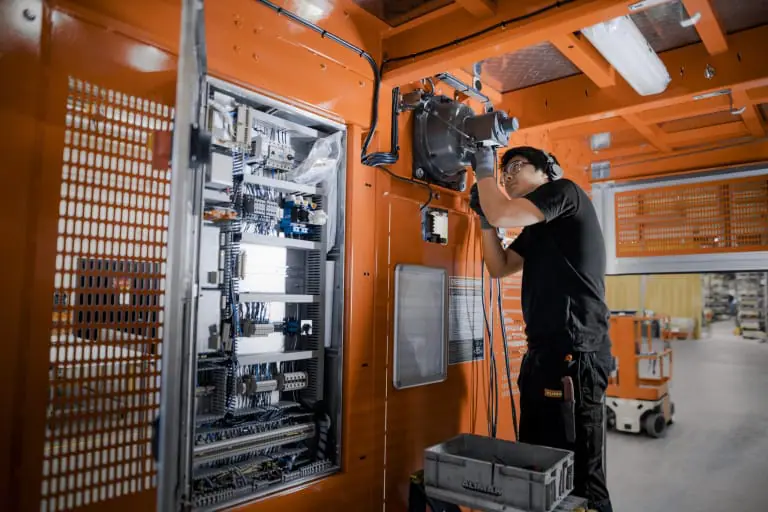
Why Containerized SoftPLCs Will Revolutionize the Industrial Edge

Industrial automation has long relied on hardware PLCs that are reliable but rigid. Control logic is tightly bound to specific devices, updates are slow and manual, and scaling across multiple sites becomes costly and complex. As industrial systems grow more distributed and software-driven, this hardware-centric model increasingly limits agility, time-to-market, and the ability to evolve at the edge.
SoftPLCs change the equation by running PLC logic as software on standard industrial computing hardware. Instead of being locked into proprietary devices, control logic becomes portable and easier to manage. When softPLCs are packaged and deployed as containers, the impact is even greater. Containerization decouples control software from hardware lifecycles and aligns PLC automation with modern edge management and orchestration practices. The result is faster deployment, safer updates, and a foundation for scalable, software-defined industrial automation.
In this article, we explain:
- Why containerization matters for PLC-based control systems
- What fundamentally changes at the industrial edge when control becomes a managed software workload
- Why the shift toward containerized softPLCs is not optional, but inevitable as industrial systems scale and modernize
What Is a softPLC in Modern Industrial Automation
A Soft PLC (Software-Programmable Logic Controller) is a software-based version of a traditional PLC that runs on general-purpose computing hardware, such as industrial PCs or embedded systems, rather than on dedicated, proprietary hardware.
Unlike conventional PLCs, which bind control logic tightly to vendor-specific hardware and firmware, a Soft PLC executes control logic as software on open, standardized components. Increasingly, this software is packaged and deployed using container runtimes, allowing PLC logic, runtime, and dependencies to be treated as a portable, versioned workload.
This containerized approach further decouples control logic from hardware, enabling consistent deployment, safer updates, and integration with modern edge platforms, while preserving the deterministic behavior required in industrial control systems.
For a broader view of how software-defined approaches are transforming industrial automation and enabling new levels of productivity and flexibility, see our earlier articles:
Modernizing Industrial Control with SoftPLCs and Unified Edge Management
Software-Defined Industrial Automation: Revolutionizing Manufacturing Processes.
Why Traditional PLC Automation Struggles at the Industrial Edge
Traditional PLCs are reliable and deterministic, but their hardware-centric design introduces limitations as industrial systems become more software-driven.
They limit agility and slow time-to-market. Changes often require site visits, downtime, and long validation cycles, making it difficult to deploy new edge applications or edge AI and to iterate quickly.
They don’t scale well across many sites. Each PLC must be provisioned and maintained individually, turning fleet-wide updates into manual, error-prone operations.
They are tightly bound to specific hardware, restricting upgradeability and making long-term evolution costly and risky.
Vendor lock-in is common, with proprietary runtimes and tooling limiting flexibility and architectural choice.
Finally, traditional PLCs are hard to integrate with modern edge orchestration and IT systems, often requiring custom gateways or parallel management stacks.The table below summarizes the characteristics across the various types of PLCs, adapted from Farnell. It outlines the evolution from early Soft PLCs to modern containerized Soft PLCs, such as Codesys and https://www.otee.io/. See our roundtable with Codesys and OnLogic.
| Feature | Traditional PLC | Soft PLC | Containerized Soft PLC |
|---|---|---|---|
| Hardware Platform | Proprietary, closed, vendor-specific hardware | Open, PC-based or embedded hardware using standard components | Open industrial edge hardware managed as a shared compute platform |
| Processing Power | Fixed and limited to the chosen PLC model | Scalable with underlying compute resources | Dynamically allocated and shared across workloads |
| Connectivity & Data | Integrated but often proprietary, limited, and costly to extend | Native IT and OT integration using standard protocols such as OPC UA and MQTT, e.g. Mosquitto | Standardized OT and IT integration with consistent networking across sites |
| Flexibility | Fixed function control workloads | Control logic alongside edge applications and edge AI | Multiple isolated PLC workloads plus edge applications on the same device |
| Programming Model | IEC 61131-3 languages with vendor-specific tooling | IEC 61131-3 plus support for general-purpose and high-level languages | IEC 61131-3 logic packaged, versioned, and deployed as software artifacts |
| Deployment and Updates | Manual, device-by-device, on-site | Software-based but often host-specific | Fleet-wide deployment, versioning, rollback, and staged rollout |
| Availability | Redundancy through hardware and network design | Software redundancy depending on setup | Supervised restarts, placement, and high availability via orchestration |
| Total Cost of Ownership | High upfront cost and incremental licensing for advanced features | Lower hardware cost and higher long-term value through software versatility and hardware resource sharing | Optimized hardware usage and reduced operational overhead at scale |
| Operating System | Proprietary real-time firmware | Open operating systems (e.g. real-time Linux) with broad driver and ecosystem support | Container runtime on open OS with strict isolation and lifecycle control |
How Containerized softPLCs Change the Industrial Edge
Faster Deployment and Updates at Scale
Containerized softPLCs enable consistent deployment of control logic across production lines, plants, or substations. Logic updates can be rolled out without replacing or re-certifying physical PLC hardware, reducing downtime and shortening change cycles. Rollbacks are predictable, and control workloads can run alongside industrial edge applications and edge AI without interfering with deterministic control behavior.
Standardized Operations for Control Systems
SoftPLCs introduce a consistent operational model for PLC workloads. Control logic can be centrally managed, monitored, and versioned, with health checks and logging applied uniformly across sites. This reduces reliance on local engineering interventions while improving visibility into the runtime behavior of control systems.
More Efficient Use of Industrial Edge Hardware
By separating control software from dedicated PLC hardware, multiple control workloads can run on the same industrial edge device. This improves hardware utilization, enables consolidation of control and compute, and allows hardware lifecycles to evolve independently from control logic, without compromising industrial reliability requirements.
Containerized softPLCs and Edge Orchestration
As Soft PLCs move from isolated deployments to fleet-wide control systems, orchestration becomes a critical requirement. Managing control workloads manually may work for a single line or plant, but it does not scale across dozens or hundreds of industrial sites.
Containerized softPLCs package control logic, runtime, and dependencies into a portable unit that can be deployed consistently across heterogeneous industrial edge hardware. This preserves existing PLC logic while removing its dependency on a specific device or vendor platform.
Edge orchestration provides the missing operational layer. It distributes Soft PLC workloads across sites, ensures availability through supervised restarts and placement, and enables monitoring, logging, and health checks using the same mechanisms as for other edge workloads. Updates and rollbacks can be coordinated centrally, without disrupting local control behavior.By adopting container orchestration, OT systems can integrate with mainstream IT practices without forcing a rewrite of control logic. Orchestration bridges IT and OT, enabling agility, visibility, and scalability at the industrial edge while respecting the constraints and responsibilities of real-time control systems.
Real Industrial Scenarios Where Containerized softPLCs Win
Containerized softPLCs show their value most clearly in environments where scale, distribution, and change are part of daily operations.
In multi-site manufacturing plants, the same control logic often needs to run across many factories with minor local variations. Containerized softPLCs enable centralized deployment, update, and monitoring of PLC logic while preserving site-level autonomy. New versions can be rolled out gradually, validated per site, and rolled back if needed, without coordinating physical PLC replacements or on-site visits.
For distributed production lines, such as packaging, assembly, or material handling systems, control workloads are often replicated many times. Containerized softPLCs allow these workloads to be standardized, versioned, and managed as software, improving consistency across lines while simplifying maintenance and troubleshooting.
In industrial IoT gateways that run PLC logic, softPLCs enable consolidation of control, data processing, and connectivity on a single edge device. PLC logic can run alongside protocol adapters, analytics, and edge applications, reducing hardware sprawl while maintaining clear separation between control workloads and higher-level processing.
Conclusion
Soft PLCs remove the rigid hardware constraints that have traditionally limited industrial automation. Containerization removes deployment and lifecycle friction, turning control logic into a portable, manageable software workload. Together, they redefine how industrial automation is built, deployed, and operated at the edge.
As industrial systems continue to scale and modernize, containerized Soft PLCs are set to become the default model for automation at the industrial edge.
Frequently Asked Questions
What is a containerized softPLC?
A containerized softPLC is a software PLC packaged as a container, including the PLC runtime and control logic. This allows it to be deployed, updated, and managed consistently across industrial edge hardware.
How is a softPLC different from a traditional PLC?
A traditional PLC binds control logic to proprietary hardware, while a softPLC runs the same logic as software on general-purpose computing platforms, decoupling control from dedicated devices.
Why are containerized softPLCs important for industrial edge computing?
They enable PLC logic to scale, update, and coexist with other edge workloads, supporting modern edge architectures without sacrificing industrial control behavior.
Can containerized softPLCs work with existing PLC automation systems?
Yes. They can integrate with existing PLCs, I/O modules, and fieldbuses, enabling gradual modernization without replacing established automation systems.
How does edge orchestration improve PLC management?
Edge orchestration enables centralized deployment, monitoring, health checks, and rollback of PLC workloads across many sites. While many softPLC solutions still focus on simplistic, device-by-device updates, orchestration addresses the real challenge at scale: fleet-wide lifecycle management across hundreds or thousands of industrial edge locations, with minimal manual intervention.
Do containerized softPLCs require cloud connectivity?
No. They can operate fully locally at the edge. Cloud connectivity is used for management and updates, but control execution remains autonomous and resilient to disconnections.